Category: Fascinating Science

  • Molten Salt Reactors — no loss of coolant accidents, no nuclear meltdown?

    Molten Salt Reactors — no loss of coolant accidents, no nuclear meltdown?

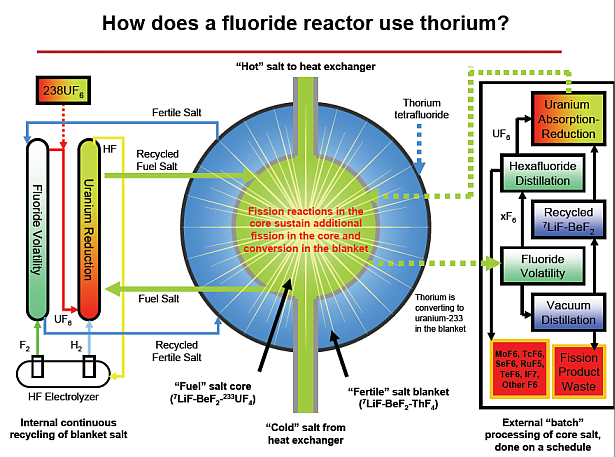
    Molten Salt Reactors (MSRs) are a type of nuclear reactor that is gaining attention in the scientific community due to their potential to revolutionize the energy industry. Unlike traditional nuclear reactors, MSRs use a liquid fuel (a molten salt) that is circulated through the reactor, eliminating the need for solid fuel rods; this allows safety, less waste, greater control over the reaction.

    One of the most significant advantages of MSRs is their inherent safety features, including no “loss of coolant accidents” and no risk of nuclear meltdown. This has made them an attractive option for countries looking to transition to more sustainable forms of energy without sacrificing safety.

    As research into MSRs continues, it is becoming increasingly clear that they could play a crucial role in meeting our future energy needs.

    A Molten Salt Reactor fissions over 99% of its fuel. Light Water Reactors (the most common type of nuclear reactor in the world, solid fueled, water cooled) only fission about 3% of their fuel.

    The waste generated in MSR is harmless within 350 years (radioactivity below background levels), with 83% of it safe in just 10 years. This is in contrast to the waste produced by Light Water Reactors, which requires storage for over 100,000 years to become safe.

    To run a 1 gigawatt Molten Salt Reactor for a year uses only 1 ton of fuel, and produces only 1 ton of waste; instead of 250 tons of waste from a solid-fueled reactor.

    MSR uses coolant that is stable even at very high temperatures, and no water — no high-pressure to contain, no loss of coolant accidents, no risk of hydrogen explosions; therefore, no massive containment structure is needed.

    Molten Salt Reactors possess natural safety features, such as the coolant won’t boil away; as well as automatic safety measures, like the secure drainage of fuel to cooling tanks where there is no chance of nuclear reaction, regardless of any power outages.

    “No water” also means that water-soluble waste products such as cesium, that in LWR can easily get into food, are instead strongly chemically bound to the fuel salt. The fuel salt solidifies (cools to solid) quickly in any leak, doesn’t dissolve in water, doesn’t chemically react with anything in the reactor or in the environment. Any accident cleanup would be a few cubic meters of chemically stable solid materials.

    Any type of MSR has an inherently stable reaction rate. The molten fuel expands/contracts with temperature, regulating fission; that strongly regulates the fuel temperature.

    While in LWR the temperature inside the fuel pellets is always higher than the materials can handle if cooling fails, in MSR the fuel temperature is always far below what the materials can handle, even without power or operator intervention.

    Aside from the obvious “the fuel is already molten”, a “nuclear meltdown” where the fuel melts through the reactor vessel, is physically impossible in MSR.

    And we even operated one for 5 years, in the 1960s. Now several companies in countries around the world are designing and starting to build them.

    Please visit my Molten Salt Reactor website. It is fascinating, and we would like what happens when we build them.
  • Sphinx of black quartz, judge my vow

    Sphinx of black quartz, judge my vow

    All from https://en.wikipedia.org/wiki/Pangram

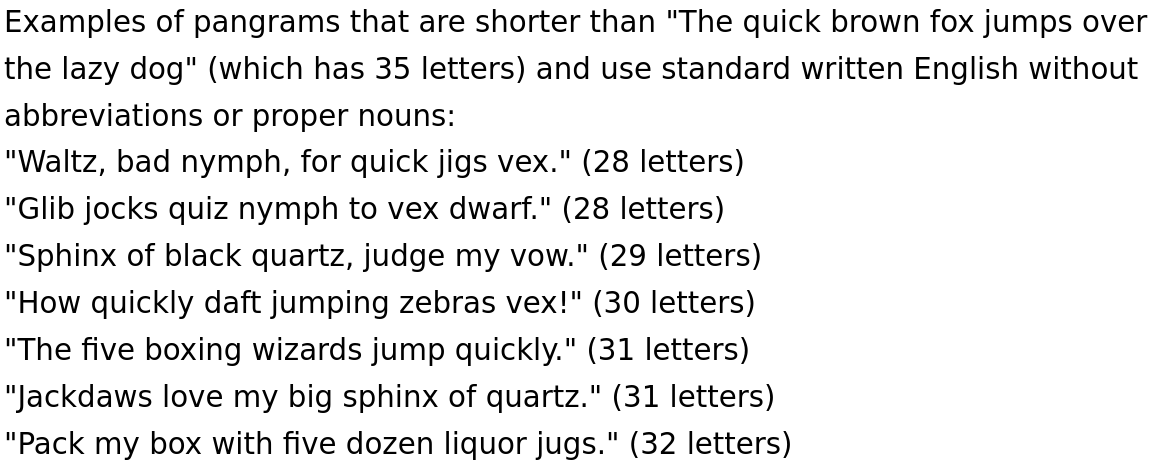
    Examples of pangrams that are shorter than “The quick brown fox jumps over the lazy dog” (which has 35 letters) and use standard written English without abbreviations or proper nouns:
    “Waltz, bad nymph, for quick jigs vex.” (28 letters)
    “Glib jocks quiz nymph to vex dwarf.” (28 letters)
    “Sphinx of black quartz, judge my vow.” (29 letters)
    “How quickly daft jumping zebras vex!” (30 letters)
    “The five boxing wizards jump quickly.” (31 letters)
    “Jackdaws love my big sphinx of quartz.” (31 letters)
    “Pack my box with five dozen liquor jugs.” (32 letters)

    Perfect pangrams

    A perfect pangram contains every letter of the alphabet only once and can be considered an anagram of the alphabet. The only perfect pangrams of the English alphabet that are known use abbreviations or other non-dictionary words, such as “Mr Jock, TV quiz PhD, bags few lynx”, or use words so obscure that the phrase is hard to understand, such as “Cwm fjord glyphs vext bank quiz” (developed by Robert L Birch (ca.1965), & improved for meaning by JRBirch), in which cwm is a loan word from the Welsh language meaning a steep-sided glaciated valley, and vext is an uncommon way to spell vexed. The meaning, clear only to those with an above average vocabulary, is less concisely that the petroglyphs found on the cwm walls of a Nordic fjord, challenged the validity of an archaeological quiz about the banks of that fjord.(–JRB)

    Spanish

    Benjamín pidió una bebida de kiwi y fresa. Noé, sin vergüenza, la más exquisita champaña del menú.
    (“Benjamin ordered a kiwi and strawberry drink. Noah, without shame, the most exquisite champagne on the menu”) uses all diacritics and the foreign letters k and w.

    Scientific Papers

    The scientific paper “Cneoridium dumosum (Nuttall) Hooker F. Collected March 26, 1960, at an Elevation of about 1450 Meters on Cerro Quemazón, 15 Miles South of Bahía de Los Angeles, Baja California, México, Apparently for a Southeastward Range Extension of Some 140 Miles” has a pangrammatic title, seemingly by pure chance. As of January 2022, its English Wikipedia article is the only English Wikipedia article to have a pangrammatic title without having been constructed as a pangram.

    https://en.wikipedia.org/wiki/Pangram

    One more: The five boxing wizards jump quickly.

  • Mexico: HEU Free

    The Rachel Maddow Show has a segment on bringing highly enriched uranium (HEU) from Mexico to the USA, part of gathering it from nuclear reactors world-wide, to USA and Russia.

    RMS 3/19/2012, http://www.msnbc.msn.com/id/26315908/ns/msnbc_tv-rachel_maddow_show/#46790266

  • Molten Salt Reactors — no loss of coolant accidents, no nuclear meltdown?

    A new kind of reactor, a Molten Salt Reactor, fissions 99+% of its fuel,

    All of the waste is completely benign in under 350 years (83% of it is safe in 10 years!)

    To run a 1 giga-watt reactor for a year, produces only 1 ton of waste, instead of 250 tons of waste from a solid-fueled reactor.

    It uses coolant that is stable even at very high temperatures, and no water — no high-pressure to contain, no loss of coolant accidents, no risk of hydrogen explosions, no massive containment structure needed.

    It has inherent safety (for example, the coolant won’t boil away), and passive safety (for example, the fuel drains safely to cooling tanks where no nuclear reaction is possible, even if there is no power).

    And we even operated one for 5 years… Now several companies in countries around the world are designing and starting to build them.

    Go read my Molten Salt Reactor site, about reactors such as Liquid Fluoride Thorium Reactor. It is fascinating and we would like what happens when we build them.

  • Sea Levels Expected to Rise Through 2100

    A report on how global warming, melting the ice in the Arctic, Antarctic, and mountains, will affect California. Conservative estimates are 1.0 to 1.4 meter increase in sea levels, by the year 2100.

    From Pacific Institute: Sea Level Rise

    • Under medium to medium‐high greenhouse‐gas emissions scenarios, mean sea level along the California coast is projected to rise from 1.0 to 1.4 meters (m) by the year 2100. Maps for the entire coast of California demonstrating the extent of the areas at risk are posted at www.pacinst.org/reports/sea_level_rise
    • A 1.4 meter sea‐level rise will put 480,000 people at risk of a 100‐year flood event, given today’s population. Populations in San Mateo and Orange Counties are especially vulnerable. In each, an estimated 110,000 people are at risk. Large numbers of residents (66,000) in Alameda County are also at risk.

  • Mona Lisa digitally restored

    The Mona Lisa has deteriorated from being exhibited even in sunlight, she was so popular. With ultra-high resolution photography in 13 frequencies of light from infrared to low ultra-violet, and with spectral analysis of the ingredients Leonardo da Vinci had available for paints, and of the varnishes used over time to protect the painting, the Mona Lisa has been “digitally restored”.

    Learn the scientific findings, by Pascal Cotte and Lumiere Technology and see the true colors and detail (including individually drawn eyelashes, and new painting techniques that gave astonishingly realistic skin), as close as we can get to what the Mona Lisa looked like when da Vinci finished what became the world’s most famous painting.

    There is a short clip showing some of the new findings about the painting, at Mona Lisa Revealed

    One good description of artist reviews at the time she was painted, and a fairly large image of the current and restored painting is at Leonardo Da Vinci’s Mona Lisa in Original Colors